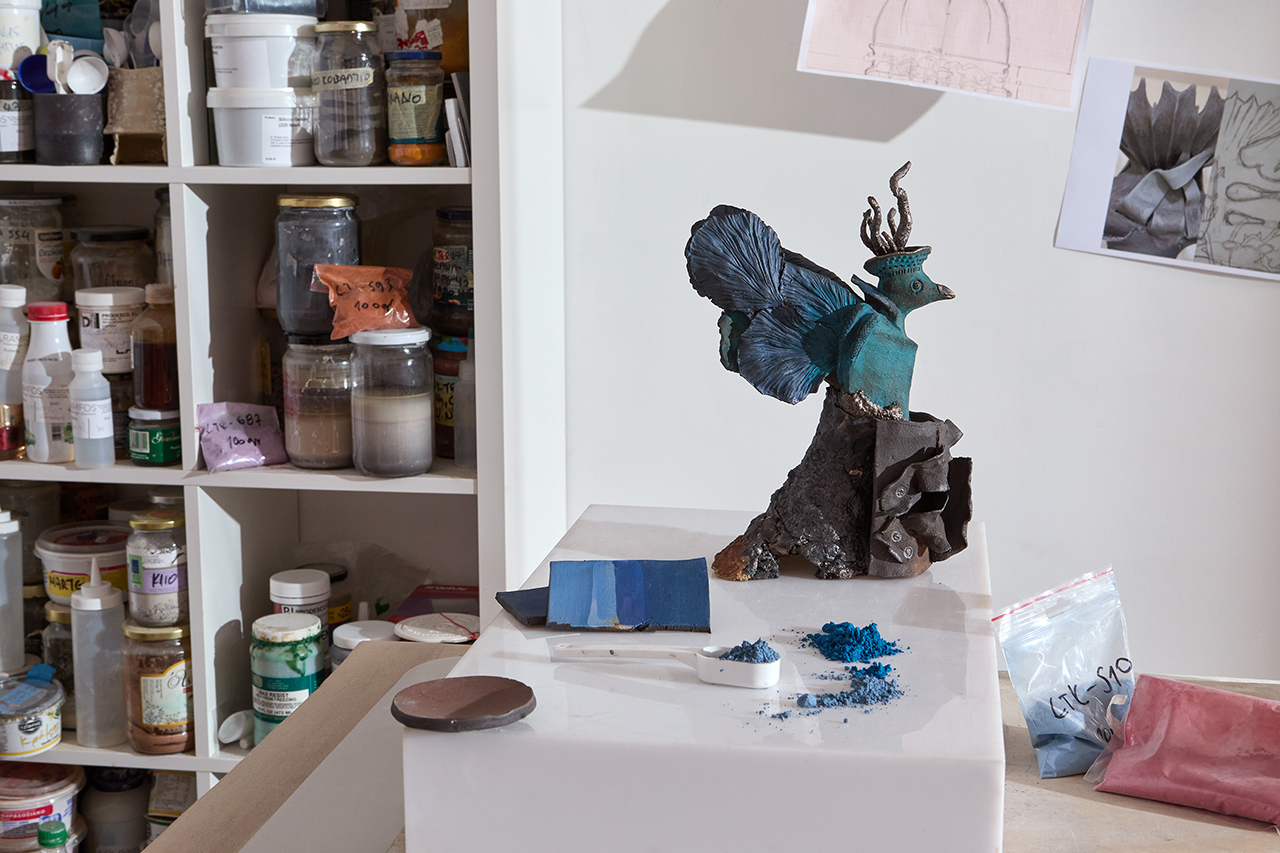
MIRKA DRAPANIOTOU’S WORK REFLECTS THE ESSENCE OF THE MATERIAL | THE AUTHENTICS MARCH 2026

What are the highlights of your journey and the key steps that brought you to where you are today?

There were various circumstances that led to inner shifts and ultimately brought me to the decision to devote myself entirely to ceramics, leaving the world of fashion behind. The transition did not happen through grand, dramatic gestures, but through many small and gradual steps. It was a quiet yet essential transformation.

A defining moment was seeing my work stand independently in an exhibition space for the first time. In that instant, I felt that the expression I had been searching for was beginning to take shape. I was also fortunate to have people around me who believed in me and encouraged me to continue with consistency and courage.

From that point on, every participation in exhibitions or Biennale, in Greece and abroad, as well as my presence in organizations such as Homo Faber, became important milestones in my journey. Each of these experiences functions both as affirmation and as a challenge for growth.

A particularly meaningful moment was when the Greek brand Zeus+Dione — which I admired and continue to admire — chose to collaborate with me on a ceramic product line. That invitation, coming from the world of fashion, felt like a symbolic circle closing and reopening at the same time, this time from a different perspective.

The story of discovering a creative path in ceramics — how was the first idea born and how did it evolve over time?

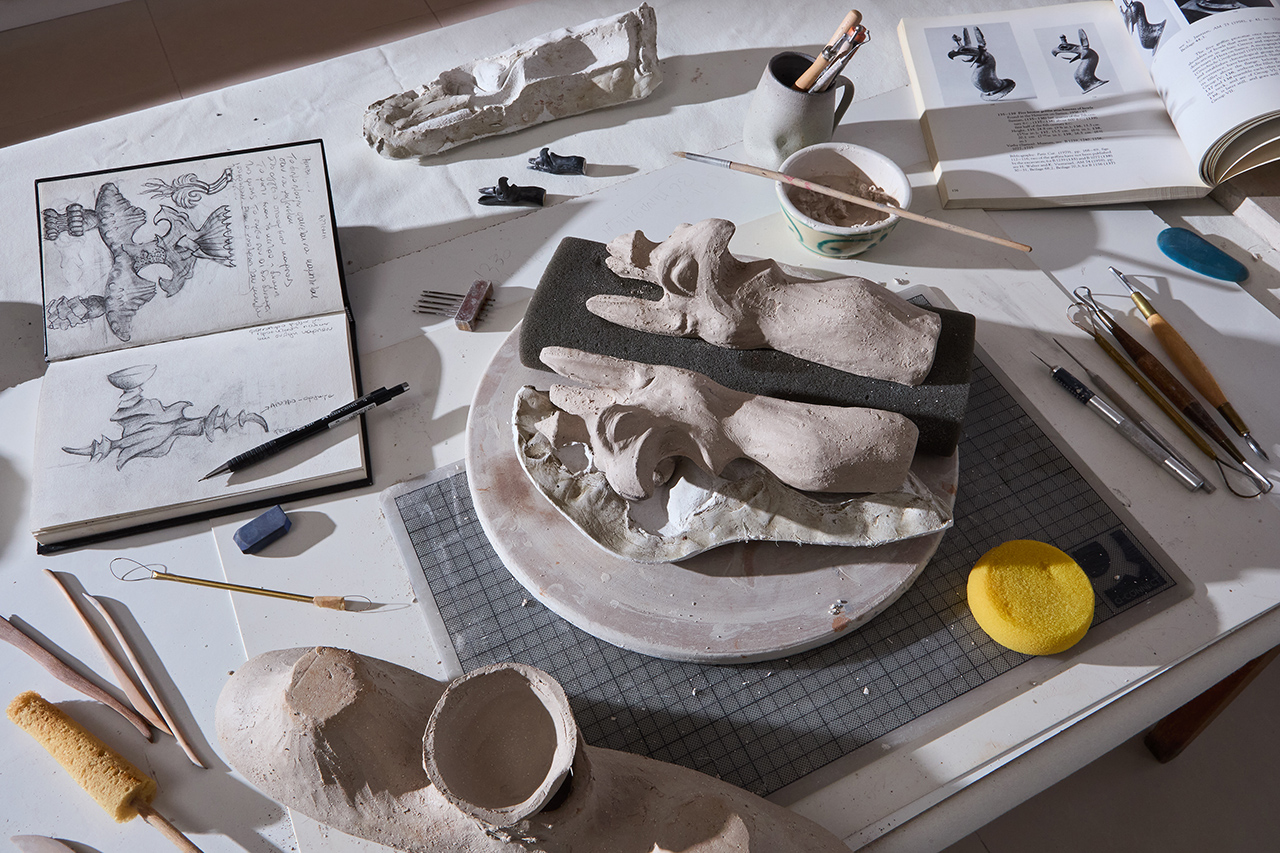
In truth, I never stopped drawing. Even after stepping away from fashion, I continued drawing lessons with two significant visual artists, Eirini Kourtidou and Stavros Bonatsos. Drawing was and remains the root of my thinking — the way I organize space, form, and tension.

In 2008, my connection with Serifos was decisive. The rocks, the colors of the mining landscape, and the strange, almost lunar textures of the terrain deeply moved me. It was there that the need to turn to clay as a means of expression was born. That summer, upon returning, I began searching for ceramics classes, not yet knowing how profoundly this decision would shift my life.

At the beginning, I was fortunate to have two exceptional teachers by my side, Marilena Michopoulou and Nikos Sklavenitis, and I feel deep gratitude for their knowledge and generosity.

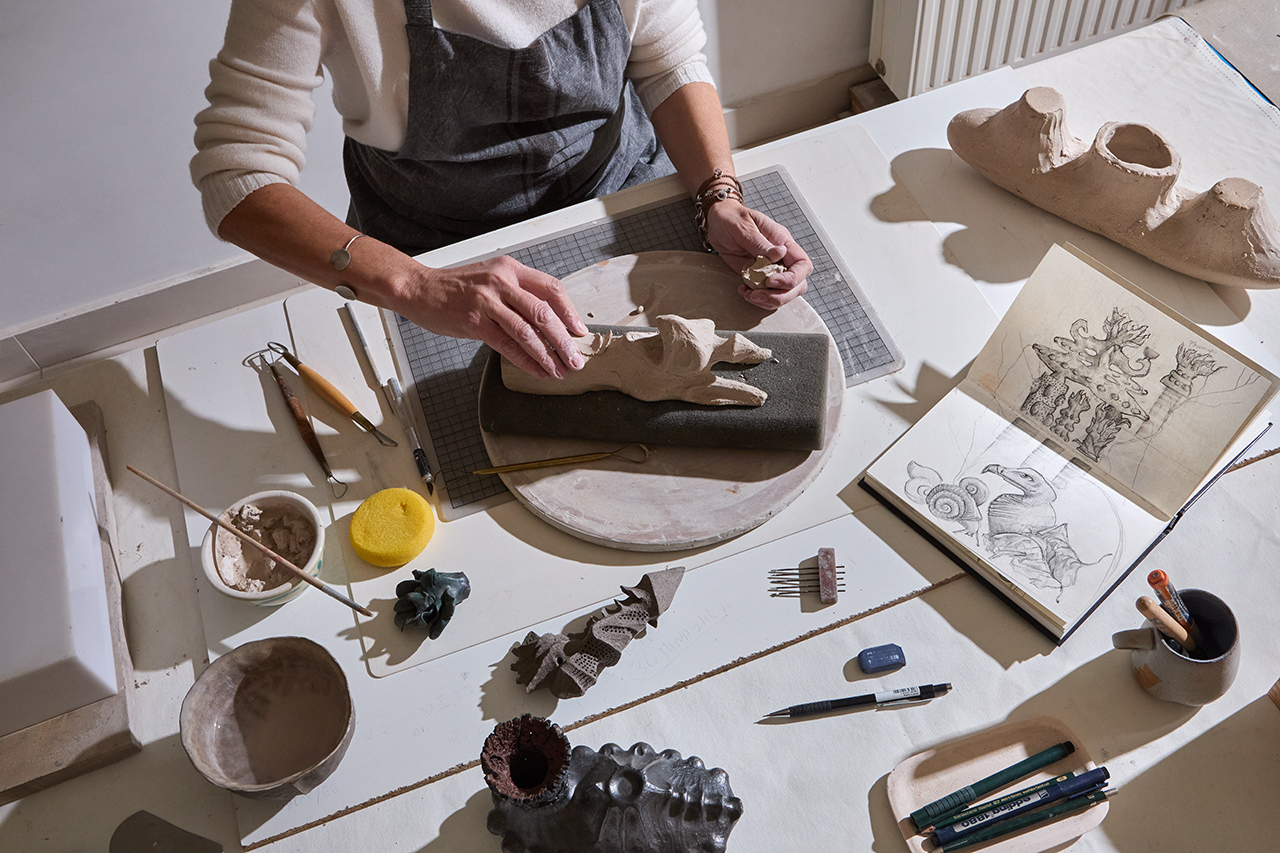
Since then, I have confronted the difficulty of clay every single day. It is a relationship of love and resistance, a constant negotiation between control and acceptance. A permanent act of persistence.

Is it a matter of education or mainly aesthetics? How do you feel your aesthetic evolves through your work?

I believe it is both. Education never stops. Ceramics is an art form that speaks directly with the elements of nature while also encompassing other arts — sculpture, architecture, painting. You are in a continuous process of learning: through form, materials, experimentation, and even through chance. Clay constantly educates you, if you are willing to listen.

Aesthetics, on the other hand, is one’s internal inheritance — everything we have seen, lived, admired, and been deeply moved by. Through continuous work and evolution, this inner identity begins to surface more clearly. And then comes the moment when, seeing it more consciously, you decide which path you truly wish to follow.

What do you feel are your most important achievements?

My most important achievement is that I consciously chose to devote myself to this material and to serve it with respect and honesty.

Ceramics is not merely a medium of expression; it is a way of life. It requires patience, acceptance of error, and humility before the process. Remaining faithful to this relationship, continuing to learn and evolve without betraying my inner direction — that, for me, is the most meaningful accomplishment.
What and who helps you move forward?

My family and friends are my most essential support system. They embrace me and offer honest advice — in both easy and difficult moments. They are the people who keep me grounded while encouraging me to move forward.

I feel truly fortunate to have them by my side.

How has your philosophy on managing your creativity evolved over time, and what do you feel holds particular value today?

For me, creativity is deeply connected to doubt. That doubt includes insecurity — not necessarily in a negative sense, but as a state of alertness. To create, in my view, means to refuse what is given, to question even what you already know, and to take risks without knowing the final outcome.

At first, this process frightened me. Uncertainty felt heavy. Over time, however, and through dedicated effort, the process transformed into a kind of game. It is like opening a new game and reading the terms — you do not yet know all the rules, but the joy lies precisely in the discovery.

At the same time, ceramics is for me a philosophy of the present. It becomes a way of life. It brings you into contact with time, with patience, with acceptance. Then small joys — a successful firing, a surface that worked, a form that “stood” — feel like meaningful achievements.

Tell us a story you remember with affection.

I remember with particular warmth a collaboration on a shared project with another artist. The act of sharing the process was deeply liberating.

The outcome — and especially the moment of installation — felt almost ritualistic. The way the work took its place in the space, the silence before seeing it fully realized, the shared breath in that moment — it is something difficult to describe.

I look forward to experiencing that again.

What do you love and what do you not about the field you work in?

I deeply love the manual aspect of creation — the physical engagement, the choreography of the hands, the silence of the studio, the relationship with the material. Ceramics requires time and patience; you cannot accelerate the process or impose your own rhythm. You must follow it with respect, almost with reverence.

Perhaps that is why I struggle with superficial approaches — with the perception that everything can be done quickly, easily, instantly. Ceramics does not function that way — and it should not.

What stories do your ceramic works tell, and what else lies within the range of your explorations?

My works convey the qualities of the material itself in every form: perforated surfaces, extremely thin walls, embossed textures, articulated balances. That, in itself, is a narrative.

My inspiration draws from ritualistic, devotional, and historical traditions, where objects function as vessels of offering and collective memory. I am particularly drawn to archaic vessels — not for their utility, but for their symbolic power.

I am deeply interested in the story the viewer creates when encountering my compositions. Each interpretation is different, and the moment it is shared with me becomes an extension of the work itself.

I often seek to place the viewer within a subtle scenographic environment, where they encounter ritual vessels and traces of memory. The human presence is not depicted — it is embodied by the viewer, who activates the space and completes the work through their own experience.

Your collaborations — and how they help expand your work.

Every collaboration is, for me, a challenge. I approach a new collaborator thoughtfully; I study their aesthetic, their philosophy, and the context in which they operate, in order to discover where and how my work can exist without losing its identity.

Of course, a collaboration may succeed — or it may not unfold as imagined. That, too, is part of the process.

In any case, collaboration takes me out of my comfort zone. It compels me to renegotiate my boundaries and to see my work through a different lens. For that alone, I consider it a profoundly positive experience.

Read full article here. 

What elevates a ceramic piece and turns it into a work of art?

Ultimately, what matters to me is intention — what you want to express and how you make that decision.

I believe a ceramic piece is elevated when the viewer can look at it without needing to immediately interpret it, when they do not try to explain it, but allow it to function as an experience.

It is in that silence before interpretation that a true connection is born.

What do you receive from your audience, and how does it help you evolve?

What I value most is when viewers offer a different interpretation of a form — a reading I had not imagined. It is deeply satisfying to see that the work can lead the viewer to another dimension, activating their imagination and gaining meanings beyond my original intention.

In that moment, I realize that the work has truly become autonomous, continuing its journey through other consciousnesses.

What’s new in your immediate plans?

I am in a new internal shift that is leading to the development of a new body of work. I am exploring humanity’s separation from the passage of seasons — that growing distance that disconnects us from natural rhythms.

I am particularly interested in ritual as a collective act, and how it has been separated from art in the contemporary era. I wonder how art might restore a sense of shared experience, functioning again as a space for gathering.

I feel this body of work will occupy me for a long time, and my goal is to share it through an exhibition.

What are the non-negotiable values in your work?

Respect for the material.

What would you like to create — a dream project?

I dream of creating a sculptural environment where the viewer is not merely standing in front, but within it. They would activate the space with their presence, becoming part of the composition rather than just an observer.

At the same time, I imagine incorporating other materials — glass, metal, and fabric. I want their textures and properties to converse with clay, creating tensions and balances, and enhancing the sense of a multi-layered, immersive environment.

Designers you admire and why

I admire many people — mostly anonymous. Those who have the courage to walk difficult paths, take risks, and take responsibility for their choices. I am moved by those who become the designers of their own lives, without following pre-made paths.

In them, I see a profound form of creativity.

Are we what we choose?

Speaking for myself, the choices I make are based on the circumstances I have at each moment. They are not always ideal, nor do they necessarily align with what I wish for — but they are the most honest decisions I can make with the tools and knowledge I have at that time.

The last thing you purchased and why

A book on dietary traditions in ancient Greece.

The best book you’ve read recently

The books I usually read relate to my ongoing research; they extend my work and feed my thinking. I would like, however, to find more time to read freely, without a goal, purely out of curiosity.

An object you could never part with

Pencil, paper, eraser.

An artist whose work you admire and would love to own

I deeply admire Iris van Herpen — the way she transforms clothing into sculptural form, combining technology with handmade work, creating bodies that seem organic, almost alive. I would love to own one of her garment-works — not merely as clothing, but as an object of art.

In another life, who would you like to have been?

A Bauhaus student, studying under those extraordinary figures who redefined the relationship between art, architecture, and craft.

Three places you love returning to and why

  • An island — for the landscape

  • A school — for the teacher

  • A journey — for the experience

Another talent you wish you had

If I hadn’t turned to ceramics, I would have liked to be an engraver. I am deeply fascinated by the process — engraving as an act of subtraction, the patience it requires, the intensity of the line on the surface. There is something ritualistic and essential in this relationship with material that moves me profoundly.

Is art a path to becoming better people?

Art is one of the paths to becoming better people.

Those who serve it sincerely help you realize your role in life — and to distinguish when it is authentic versus performative. That awareness alone, that moment of internal reflection, leads to maturity.

A museum and work that stole your heart

I remember a female statue at the National Archaeological Museum that I could not take my eyes off. The movement of the body, the slightly bowed head, that sense of interiority within stillness captivated me.

What do you consider true happiness?

Happiness lies in moments — small, almost imperceptible — that require our presence to be recognized. Perhaps, in the end, happiness is the ability to inhabit the present.

Your own definition of beauty

Beauty is a standard that overwhelms our era. In my view, true beauty exists in the background. As Coco Chanel said: “Beauty begins the moment you decide to be yourself.”

What do you consider authentic today?

Today, everything seems focused on the perfect image. Yet, as Erving Goffman explained, social life often functions as a stage where we perform a role. For me, true value lies in the “background” — in the truth, uniqueness, and imperfection of real life.

If you were to design something for TheAuthentics.gr, what would it be?

A collection of plates and candlesticks, with the sun as the central motif — as we used to draw it as children.